
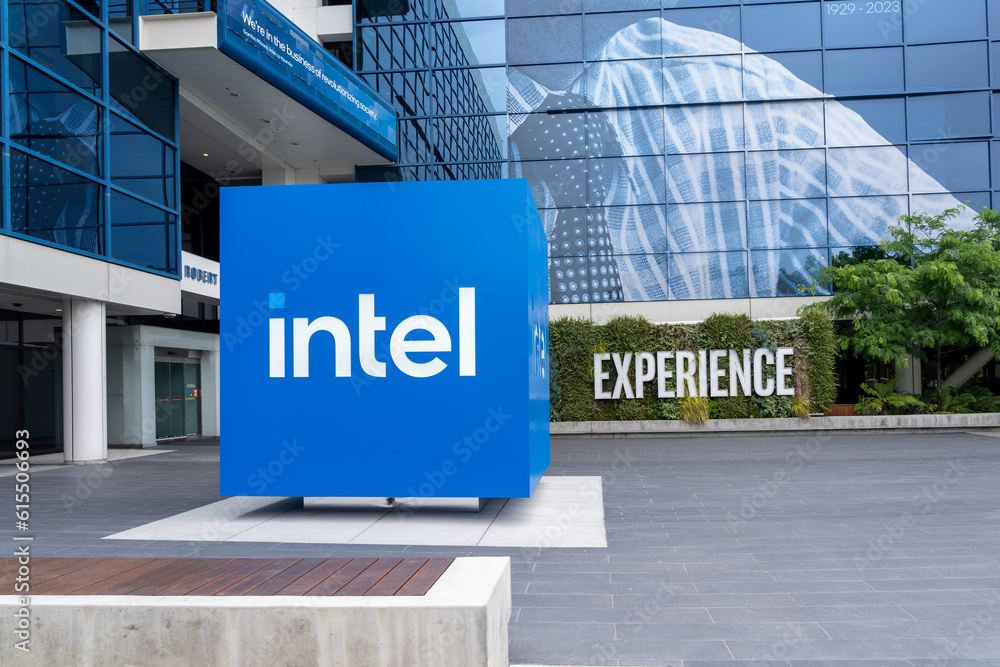
Source: Adobe Stock. Intel HQ exterior
U.S. chipmaker Intel has returned to profit after a significant turnaround in their third quarterly (Q3) earnings report, defying analyst expectations.
Reporting profits of $4.1bn, the silicon-valley veteran landed in the green, representing a $20.7bn increase in retained earnings year-on-year (YoY).
A statistic which defied analysts’ expectations, projecting an originally flat earnings-per-share estimate of $0.
“Our Q3 results reflect improved execution and steady progress against our strategic priorities,” said Lip-Bu Tan, Intel’s CEO.
A statement of prevailing confidence from the CEO, the “improved execution” of the firm arrives following a consortium of large-scale investments.
Unveiled in their Q3 report, Japanese firm SoftBank, owner of chipmaking rival ARM, pledged an investment of $2bn in the firm. This was met in tandem with a $5.7bn investment from the U.S. government, both of which are projected to increase the Intel’s operational flexibility, according to their Q3 press release.
In an effort to salvage the company from a three-year decline in its annual profits, these investments followed the September announcement of rival powerhouse Nvidia, pledging $5bn to Intel’s cause in what has been labelled as a “historic collaboration” by Jensen Huang, CEO of Nvidia.
Since its announcement, Intel has enjoyed a month-long climb in its share price, now trading at $38.
The return of Intel’s prosperity remains in question, however, considering a J.P. Morgan equities report, assessing the implications of the deal for both companies.
“Digging deeper though, we view NVDA [Nvidia] as by far the larger beneficiary of this arrangement, as it opens up an entirely new swim lane for revenue growth (iGPU market) and broadens NVDA’s market opportunity for rack-scale AI systems”.
The report continues, claiming “for INTC… we think this is only marginally positive on the Client PC side”, begging the question, have Intel entered a surrender state?
As reported by the website macrotrends.net, Intel’s share price has been enduring interminable declines since the beginning of 2024.
The possibility of recovery is sceptical amongst investors.
Paul Franke, a private investor and former Editor and Publisher of the Maverick Investor newsletter, widely quoted by CNBC and The Washington Post claims, “Intel’s total enterprise valuation is now quite stretched, with operational performance and guidance lagging behind the recent share price surge.”
Franke is downgrading his Intel 12-month outlook as he posits “sizeable revenue and earnings growth is needed.”
Comments