
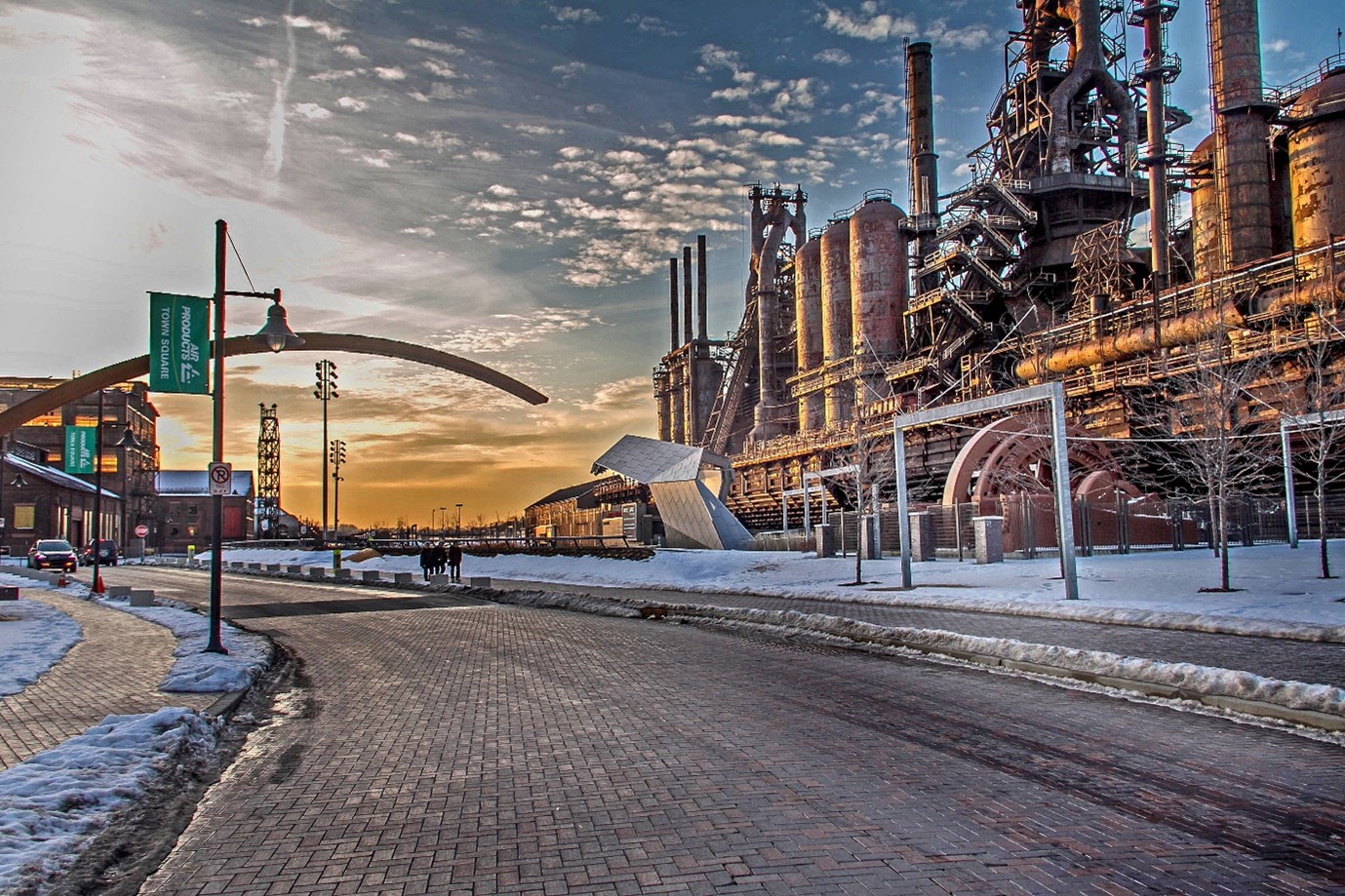
Source: Adobe Stock. Derelict Bethlehem steel mill illuminated by the winter sunshine.
“No one here wants to bring the steel industry back,” said Chad, recalling how some professors would end their working days to be greeted with a thick layer of soot smothering their cars.
“Some people argue that the steel mill shutting down is the best thing that ever happened to this place.”
“Well, we’re living in Allentown
And they’re closing all the factories down
Out in Bethlehem, they’re killing time
Filling out forms, standing in line” – Allentown
A former hotspot of post-war industrialism and topic of Billy Joel’s 1982 single Allentown, Bethlehem, Pennsylvania is heralded for its former steel works, aiding in the construction of many notorious American superstructures including the Golden Gate Bridge, George Washington Bridge and Empire State Building.
Like a dying star, Bethlehem Steel’s operations began to seize in the early 1990s, completely ending production in 1995. Today, 30 years after its closure and unbound from the shadow of the mill, Bethlehem has secured its economic future… or so residents thought.
The efforts of President Donald Trump to re-consolidate American industrial power, most recently, his expansive ‘liberation-day’ tariff policy has created new possibilities surrounding the return of industrialism in the rust belt.
“Other steel companies are coming to Pennsylvania now because they don’t want to spend 100, 50, 25 per cent on tariffs, they’re all coming in,” said the president on a mid-December trip to Mount Pocono, 40-miles up the road from Bethlehem.
Describing Trump’s policy as “totally misguided” Chad Meyerhoefer, the Arthur F. Searing Professor and Chair of the Department of Economics at Lehigh University has expressed unwavering concern.
“Trying to support the coal industry and the steel industry here would make no sense from an economic standpoint,” he said.
“All you would do is draw resources from productive sectors back into a sector that could only survive through protection and government subsidies, and we eventually doomed to failure.”
Emphatic of steel’s incompatibility with Bethlehem’s more contemporary economy, Meyerhoefer looked proudly upon the towns transition.
“It’s now a very diversified economy. That’s why it’s been fairly robust recently,” he stated.
With a growing population of around 80,000, Bethlehem is seemingly doing well for itself. 40 per cent of residents possess a bachelor’s degree, a growth rate exceeding that of the broader national growth rate, as reported by the US Census Bureau.
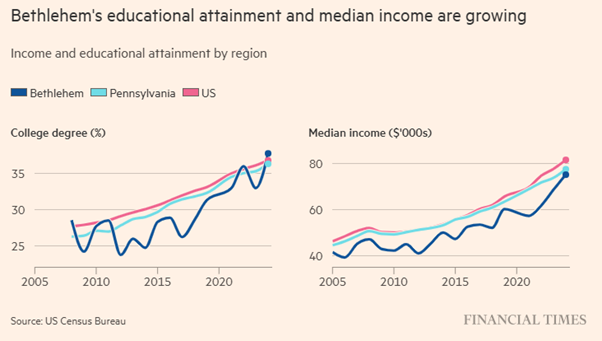
Median incomes for residents have also risen, edging ever closer to the $80,000 mark and the US’s national average.
Despite a somewhat haphazard wealth trajectory, Bethlehem, once embalmed in the industrial pollution of the steel mill, has curated a harmonious median standard of living, predicated on a marked transition to the service sector.
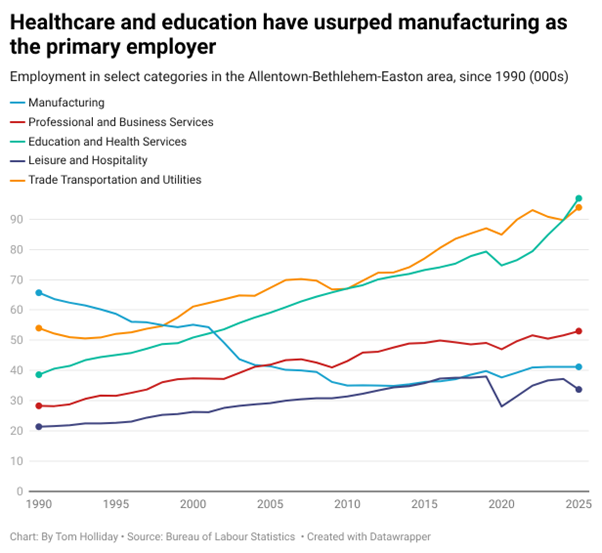
Since the collapse of steel operations in the 1990s, manufacturing roles in the Allentown-Bethlehem-Easton area have declined exponentially, losing about 1/3 of roles since 1990, as reported by the Bureau of Labour Statistics.
In its place, the area is propped up by an employment boom in education and health services with over 90,000 people employed in the sector.
“We like the major industries here,” said Meyerhoefer. “Logistics, healthcare… and education is pretty big too”
“The healthcare industry has been growing just because of the demographics of Pennsylvania. It’s one of the oldest states in the country”, he said, complimenting a string of reliable payments from federal sources to the Medicare program.
The tenured professor talked of a “huge boom” in the logistics market.
“If you think about during COVID [COVID-19], everybody switched to doing mail order. That caused a huge boom here in the logistics market.”
“We have transfer centres for all these different companies,” he continued. “This has caused the area to explode with warehouses, and trucking and logistics companies.”
Despite the seemingly welcome reception for all these potential employers, the lower-income Bethlehem residents have found themselves continually subservient to the nationwide problems in affordability. This includes unprecedented issues in housing and other essential goods.
“During COVID, we’re looking at 30-year mortgage rates that were as low as like 2.5 per cent… and now they’re like over 7 per cent,” said Meyerhoefer.
In a recent State of the Union address, the president claimed to have overseen decline in mortgage rates, lowering costs for homebuyers.
“Low interest rates will solve the Biden-created housing problem while at the same time protecting the value of those people who already own a house,” he said. This statement opposes recent data from the Atlanta Fed, estimating that the median home price has risen by more than a third since 2021 to just under $400,000.
Bethlehem locals have also endured the consequences of severe food inflation with rising foot traffic seen in soup kitchens.
As rising prices continue to marginalise lower-income Pennsylvanians from their richer neighbours, questions surrounding re-industrialisation only continue to become more pertinent.
Mike Piersa, Historian at Bethlehem’s Natural Museum of Industrial History looked fondly on the glory days of Bethlehem Steel.
“There was a time when you could leave school, walk straight to the mill, and know you’d earn enough to raise a family. That kind of certainty sticks with people,” he said.
He continued, highlighting not only the economic stability the mill provided but also its cultural importance to the surrounding community. “Steel wasn’t just work here. It was who the city was – stability pride and identity all coming together.
Bethlehem Steel employed 300,000 people worldwide after World War II, with around 10 per cent of those people working at the Bethlehem plant alone, a portion of whom still reside locally.
The Steelworkers Organisation of Active Retirees (SOAR), comprised of twenty odd men and women, continue to meet monthly in the bowels of the United Steelworkers headquarters. SOAR failed to comment following Trump’s statement.
Today, as according to recent data, the Allentown-Bethlehem-Easton area has a preliminary unemployment rate of 3.9 per cent, with over 17,000 people out of work.
Despite his nostalgia for what is unequivocally an institution of American industrialism, Piersa proved even the fondest industrialists aren’t completely on board with Trump’s intentions.
“Most people also know Bethlehem isn’t the same place it was forty years ago,” he said. “The economy has moved on, whether people like it or not”, he continued, citing concerns around affordability.
“Bringing steel back could actually make things more expensive – not cheaper – if it tightens housing or pulls investment elsewhere,” he argued.
“Bethlehem Is Back”
Throughout his second term, Trump has undoubtedly displayed a romantic devotion to American history, revelling in the industrial feats of the greatest generation. Whether Trump can foster a return to history is one thing, but whether his voters approve is another.
Comments